Auckland


Navigating water storage:
a practical guide for farmers
Turning drought risk into growth opportunity
The increasing frequency of severe drought and flood cycles across New Zealand means water security is no longer a luxury – it is a critical necessity for maintaining farm viability and production. However, securing the necessary consents to build storage is often complex and costly.
Riley understands the challenge: protecting and improving your pasture health should be straightforward and efficient, not weighed down by unnecessary complexity. We partner with New Zealand farmers to provide a sustainable, fully managed water storage design, handling the technical design, compliance, and council coordination from initial feasibility right through to long-term operational assurance, allowing you to focus on long-term business growth.
PHASE ONE
The cost of insecurity: understanding modern drought impact
The impact of dry periods extends far beyond visible dry grass. Without consistent soil moisture and pasture health, farm profitability is severely threatened.
-
Soil health collapse: Prolonged dryness devastates microbial activity in the soil. This scenario results in elevated nutrient leaching. Recovery is slow, meaning subsequent seasons require higher, more costly nutrient applications to support grass growth.
-
Economic strain: Inconsistent feed production necessitates expensive imported feed, directly reducing profitability and cash flow. There are a number of hidden costs including the cost to destock then restock if feed options are exhausted, and the unmeasurable stress on staff that impacts attracting and retaining talent.

Key insights
For many dairy and horticulture operations, consistent water supply for irrigation is the fastest pathway to enhancing resilience and ensuring reliable farm performance.
PHASE TWO
Unlocking storage: Solving the regulatory challenge
The significant barrier to achieving water security is often the regulatory process. Water storage projects are classified as either small or large (exceeding 4m in height and 20,000m3 in storage volume).
The problem of scale: when consent triggers building act requirements
For any significant storage volume, the project will typically trigger requirements under both the Resource Management Act and the Building Act.
-
Earthworks and volumes: You will likely require a Resource Consent for the earthworks, which addresses environmental effects like runoff and ecology.
-
Water Take permits: You will need a Resource Consent for Water Take to legally abstract the water required to fill the storage.
-
Dam safety: A large dam requires a Building Consent and a formal Potential Impact Classification (PIC) assessment, which can increase the design and compliance complexity together with the project timeline.
The Riley solution
We begin every project with a Desktop Feasibility Assessment to quickly identify regulatory triggers, assess hazards at a high level, and provide a clear, high-level construction cost for the storage you need, enabling you to make an informed decision on project progression.
Moving beyond complexity with sustainable design
Riley champions offline water storage solutions, such as the Turkey Nest Dam, as they offer a significant advantage in the consenting process compared to building in a natural waterway (on-stream).
WATER SOURCE
Turkey nest (offline)
Pumped from river during high flow, or rainwater capture.
Traditional dam (on-stream/gully)
Built directly across a natural river or stream bed.
Turkey nest compliance advantage
Minimal impact on existing waterways.
FISH PASSAGE
Turkey nest (offline)
Fish screens required to keep the fish out. Storage is offline.
Traditional dam (on-stream/gully)
Must include design elements to ensure fish migration.
Turkey nest compliance advantage
Removes a major ecological hurdle
in consent.
SEDIMENT RUNOFF
Turkey nest (offline)
Lined or unlined, e.g. with HDPE. Controlled design minimises the risk
of sediment transfer to natural waterways.
Traditional dam (on-stream/gully)
Disturbance to the stream bed increases the risk of sedimentation and erosion.
Turkey nest compliance advantage
Superior environmental outcomes.
PHASE THREE
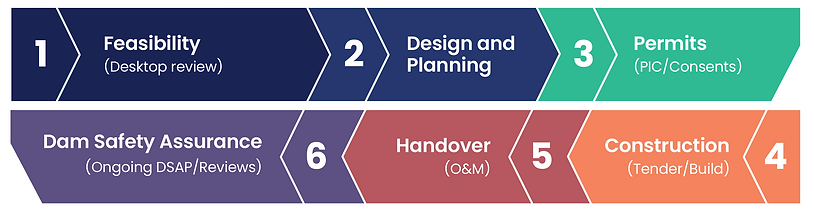
The end-to-end managed process
Riley provides full coordination and project management, removing the administrative burden from the farmer.

1. Planning and feasibility (the critical start)
This is the most critical phase for minimising risk and cost.
Needs assessment: Define your desired level of pasture growth and future business goals to determine the precise storage volume required (in cubic metres).
Desktop feasibility: Riley conducts a high-level site selection, assesses natural landforms, identifies potential geological hazards, and provides an indicative construction cost per cubic meter of storage.
The PIC assessment: If the volume triggers the large dam rules, a preliminary PIC is determined, which dictates the level of engineering rigor required for the consent and construction.

2. Regulatory and design
Riley coordinates all experts for the necessary consent applications.
Expert coordination: We align with irrigation consultants, planners, ecologists, and surveyors. This includes managing the geotechnical investigation and addressing design, seismic, and liquefaction issues.
Permit application: The consent application, including the mandatory Assessment of Environmental Effects (AEE), Detailed Design plans, and Dam Break Analysis are prepared and submitted. This includes mandatory Iwi consultation, which we coordinate with the project planner.
Council liaison: We act as the single point of contact with the project planners, for the Council, managing all Requests for Information (RFI) and stakeholder negotiations.

3. Construction and handover
We manage the execution, ensuring quality and budget control.
Tender and contractor management: We run the tender process, evaluate contractors, and manage the build contracts. We work with trusted partners who prioritise project success over maximising variations.
Construction oversight: On-site management, quality checks (engineering compliance monitoring fill compaction control), and strict control over time and budget.
Commissioning: Final inspection and handover, including Operations & Maintenance (O&M) manuals and a commissioning plan to ensure long-term, safe functionality.

4. Dam safety assurance: your partner in long-term care
Building your asset is only the first step. For larger dams (those triggering PIC), compliance is an ongoing legal requirement. Riley ensures your asset remains safe, compliant, and performing optimally for its entire lifespan.
Our dam safety services
Riley provides specialist engineering services, managed by a Recognised Engineer, to satisfy the regulatory requirements mandated by the Building Act. The scale and frequency of some requirements are dependent on the dam’s rating.
-
O&M planning: We develop your mandatory Dam Safety Assurance Programme (DSAP). This document acts as the ‘owner’s manual’ for the dam, providing clear, simple O&M Manuals to guide your team in routine monitoring and maintenance. This is typically reviewed every five years.
-
Staff empowerment: We provide essential training to farm staff, enabling them to undertake the required visual checks for compliance.
-
Safety reviews and reporting: We conduct Intermediate Dam Safety Reviews (IDSRs) annually to review performance records and provide early warning signs of change. Every five years, we organise the Comprehensive Dam Safety Review (CDSR), which is conducted by an external, independent Recognised Engineer to confirm the dam is performing as designed.
-
Investor confidence: The annual inspection is conducted by a Riley Recognised Engineer, and the resulting comprehensive report can be shared with investors and the board, providing vital comfort and security about the long-being of the dam as a core asset.
-
Emergency preparedness: We ensure you have a compliant Emergency Action Plan in place, outlining clear steps to protect people and property in the unlikely event of a dam failure. This plan is annually tested and reviewed.
The Riley project roadmap
PHASE THREE
The Fairlea Farm advantage: a proven ROI
The Fairlea Farm Reservoir project is a clear example of how strategic storage delivers a significant Return on Investment (ROI) by increasing on-farm efficiency.
Asset security and investment: The dam is established as a secure, long-term asset, giving the board/key stakeholders confidence to make strategic investments and manage future growth without the threat of drought-related uncertainty.
Feed security: Consistent water access eliminated the need for supplemental imported feed, leading to significant cost savings.
Production consistency: Reliable irrigation stabilised soil moisture, leading to better dry matter yield and increased milk solids production, even during dry summers.
Compliance certainty: The offline Turkey Nest design successfully navigated the consent and compliance process, providing a future-proof asset.
“There are a bunch of hidden costs in having dry summers other than purchase feed costs... like pasture death from dry or overgrazing, subdued return to normal in the following season, the cost to destock then restock if options for feed purchase don’t exist.”
Doug Dolan, Belgroup/Fairlea Farm, on the Costs of Insecurity

WANT TO KNOW MORE?
Get in touch with our team to discuss your specific needs and explore how strategic storage can deliver a proven return on investment, much like it has for our partners at Fairlea Farm.